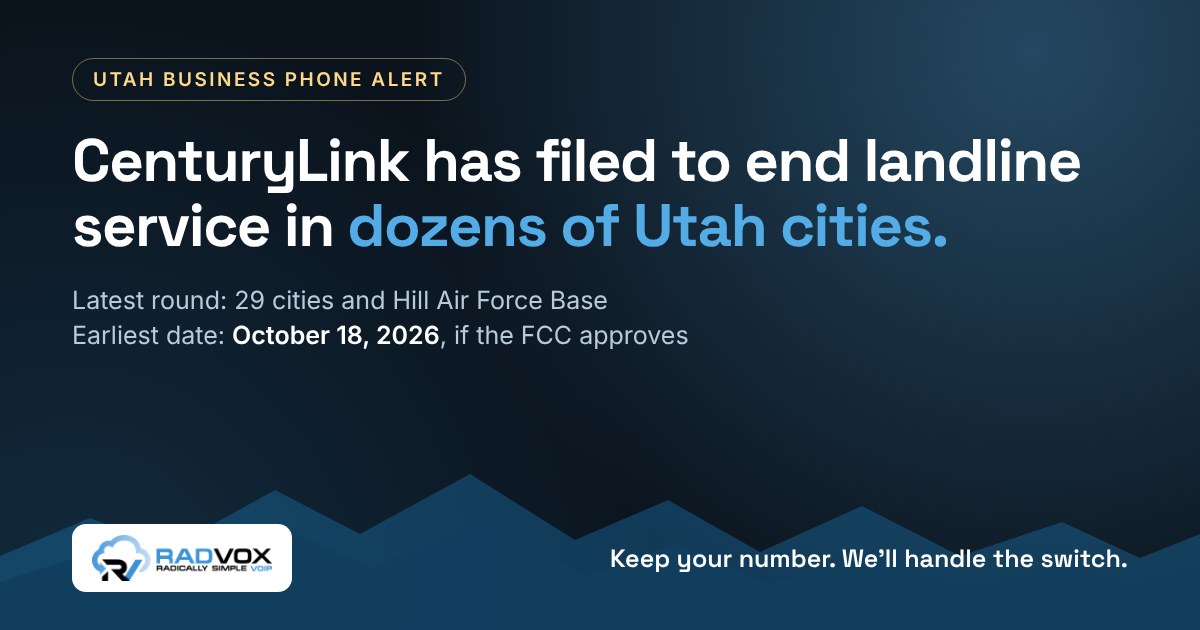
If a letter from CenturyLink landed on your desk in late August with the heading “Important Notice Regarding the Plan of Qwest Corporation d/b/a CenturyLink QC to Discontinue Voice Services in Your Area,” it’s real, it isn’t junk mail, and it has a date on it. We’ve been getting calls about it all month, so here’s the plain-English version from your phone guys in Sandy — which, yes, is on the list.
What CenturyLink actually filed
In an application dated August 25, 2026, CenturyLink asked the Federal Communications Commission for permission to stop offering what it calls “legacy voice service” — the traditional landline that handles one call at a time. The filing’s own words: “as of October 8, 2026, or as soon thereafter as CenturyLink obtains the necessary regulatory approval.”
The notice names these Utah communities: Clearfield, Clinton, Copperton, Cottonwood Heights, Draper, Farmington, Holladay, Hooper, Kearns, Kaysville, Layton, Logan, Magna, Midvale, Murray, Ogden, Park City, Roy, Salt Lake City, Sandy, South Jordan, South Salt Lake, Sunset, Syracuse, Taylorsville, Washington Terrace, West Jordan, West Point, West Valley City and Hill Air Force Base.
According to the filing, 4,898 Utah customers still have the service — roughly 2% of the “living units” CenturyLink counts in those areas — and it describes the service as “outdated and prohibitively expensive” to maintain. Notices went out by mail on August 19 and August 25.
October 8 or October 18?
CenturyLink’s letter says on or after October 8. The FCC’s public notice, released September 17, sets a slightly later clock: unless the agency says otherwise, the application is deemed granted automatically on October 18, 2026, and CenturyLink may discontinue service on or after that date.
As of this writing, October 3, the request is still pending, so the day could move. We wouldn’t plan a business around a delay.
It isn’t the only filing this year
- Spring: Springdale. CenturyLink filed the same kind of application for its Springdale wire center. It was deemed granted on April 9, and the Utah Public Service Commission issued its order on May 22.
- July: 67 Utah cities. An application dated July 9 covers legacy voice lines delivered over fiber that CenturyLink has since sold to AT&T, in 67 Utah cities from Bountiful and Tooele to Provo, Orem, Lehi, Heber City, Cedar City and St. George. The date on that one: on or after August 24, 2026.
- August: the 30 communities above. The same filing adds that, although “no definitive plans have been made,” CenturyLink anticipates seeking authority to discontinue legacy voice service for customers served “via special circuits.”
What the letter tells you to do
Two versions of the August notice went out. One points customers to CenturyLink’s own replacement, “Connected Voice with Air-Line,” which it describes as “a feature-rich, digital home phone service.” The other skips the replacement and says: “To ensure uninterrupted phone service, you will need to transfer your service to another provider in your area.”
Either way, if the FCC signs off, the line goes away and you have to choose what replaces it.
Your options, honestly
1. CenturyLink’s cellular adapter. Your existing phone plugs into an adapter that connects over the cellular network. The August filing lists it at $30 per month per line plus taxes, surcharges and fees, and you keep your number. For a house it may be all you need. For a shop it’s a tighter fit: CenturyLink’s own product page says it’s not recommended for fax, point-of-sale credit card transactions or security systems.
2. A like-for-like line from another carrier. Cable and wireless companies sell basic phone lines too. You get dial tone back, one call at a time, with the same limits the old line had.
3. A real business phone system. Same number, but it answers with your greeting, takes several calls at once, rings the counter and your cell, and emails your voicemail. That’s hosted VoIP, and it’s what we do all day.
The one mistake to avoid: don’t cancel first
A phone number can only be transferred while the line is still active. If the line gets disconnected — by you or by CenturyLink — there’s no guarantee you get that number back. So the order matters:
- Pick your new provider.
- They request the number transfer (the industry calls it a “port”).
- Your number moves, and the old line ends.
The good news is in the letter itself: CenturyLink says no early termination fees apply if you leave before the discontinuance.
What to have ready
- A recent CenturyLink bill. It has the account number, the exact name on the account and the service address, which is what a transfer needs.
- Every number you want to keep. Main line, fax line, the rollover line nobody remembers.
- Everything plugged into a phone jack. Fax machine, card reader, alarm panel, elevator phone, gate or door entry. Each one needs a plan, and some need their own vendor.
Fair is fair: the power question
Old landlines carry their own power, which is why the phone worked when the lights were out. No modern replacement does that — not a cellular adapter, not cable, not VoIP. Both versions of CenturyLink’s August notice say as much about VoIP and wireless service, and it’s true of ours.
So we plan for it: a small battery backup for your internet and phones, and calls that ring your cell through the ConnectUC app when the office is dark. A power outage at the shop doesn’t have to mean a dead business line.
What it costs
CenturyLink’s August filing lists its business single-line voice service in Utah at $69.00 per month, with long distance and additional calling features extra, and its Air-Line replacement at $30 per month per line — each plus taxes, surcharges and fees. Radvox plans run $17.95 to $34.95 per user per month before taxes and fees, with unlimited US/Canada calling and the features included. We’ll quote from your actual bill so you see the real before-and-after.
Switching? Your first month is on us. Mention that you’re moving from CenturyLink — or any other carrier — and your first month with Radvox is free. We handle the number transfer, install everything at no charge, and there’s no contract. See how the switch works, or call or text 801-990-4444.
If you got the letter, the calm move is to start now, while your line is still live and the choice is still yours. We’re down the road, and a real person answers.
Sources
- Section 63.71 Application of Qwest Corporation d/b/a CenturyLink QC, dated August 25, 2026, with sample customer notices dated August 19 and August 25, 2026 (copy posted by the Utah Public Service Commission): the 30 communities, the October 8 date, customer count, prices and quoted notice language. The notice spells Kaysville “Keysville.”
- FCC Public Notice DA 26-993, WC Docket No. 26-242, released September 17, 2026: the October 18 date.
- Section 63.71 Application of Qwest Corporation d/b/a CenturyLink QC, dated July 9, 2026, with customer notice dated July 7, 2026, and FCC Public Notice DA 26-773, WC Docket No. 26-176: the 67 cities and the August 24 date. The notice prints American Fork as “America Fork.”
- Utah Public Service Commission Order, Docket No. 26-049-02, issued May 22, 2026: Springdale.
- CenturyLink, Connected Voice with Air-Line product page, viewed October 3, 2026: replacement-service limitations.
Status is as of October 3, 2026. The August application is subject to regulatory approval, and CenturyLink’s dates and prices may change. Radvox is an independent company and is not affiliated with CenturyLink or Lumen; CenturyLink is a trademark of its owner.
Got the letter? Let’s get your number moved.
Free consultation, free installation, no contract — and your first month free when you mention the switch.